A patient’s real-life experience—and what you should know before choosing laser therapy after an injury.
Sometimes pain does not fully appear immediately after a fall. You may initially feel shaken but relatively comfortable, only to notice increasing soreness, stiffness, swelling, or bruising several hours later.
That is what happened to one of our patients.
“I Think I’m Okay… But I’m Not Totally Sure Yet”
She was walking downstairs at home, planning to go outside and play with her children. While wearing athletic socks, she slipped and slid down several steps.
Her family heard the fall and called out:
“Mom, are you okay?”
Her honest answer was:
“I think so… but I am not totally sure yet.”
At first, she rested, applied ice, and hoped the discomfort would settle. Over the next several hours, however, she began feeling tightness through her gluteal area and pain in her lower back.
By the following day, bruising was developing, and her movement still did not feel normal.
Because she was already familiar with our clinic, she contacted us.
Why Can Pain and Bruising Appear Later?
After a fall, the body’s initial stress response can temporarily make an injury feel less noticeable. Irritation and inflammation in the affected tissues may become more apparent over the following hours.
Bruising also takes time to become visible as blood from damaged small vessels collects beneath the skin. This is why someone may initially feel “mostly okay” but notice more soreness, stiffness, or discoloration later that day or the next morning.
Delayed symptoms do not automatically mean that an injury is serious. However, they should not be ignored—especially if pain is increasing, movement is becoming difficult, or neurological or head-injury symptoms are present.
Clinical Assessment Comes First
Before providing treatment, Olga Kaltsou, DPT, completed a clinical assessment to check the patient’s symptoms and screen for signs that could require additional medical evaluation, including a possible fracture, head injury, or neurological involvement.
Laser therapy should not be used as a substitute for an appropriate clinical or medical evaluation after a fall.
In this case, the assessment indicated that Deep Tissue Laser Therapy could be used appropriately as part of the patient’s care.
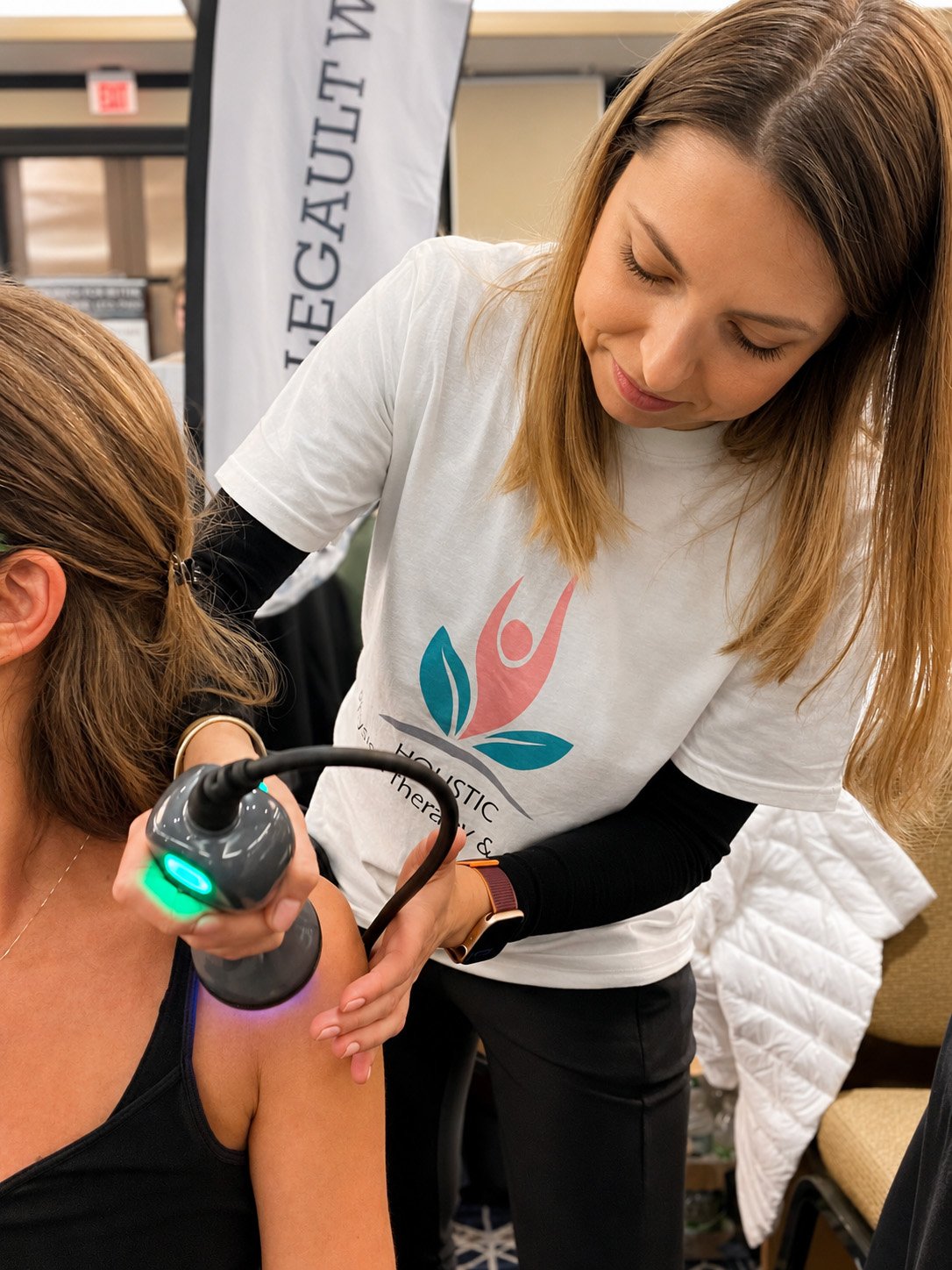
What Is Deep Tissue Laser Therapy?
Deep Tissue Laser Therapy, also known as Class IV Laser Therapy, uses specific wavelengths of light delivered to the treatment area.
When clinically appropriate, it may help:
Reduce pain
Calm irritated tissue
Reduce inflammation
Improve comfortable movement
Support the body’s natural recovery process
At Holistic Physical Therapy & Pilates, laser therapy is selected according to the individual patient’s symptoms, health history, and clinical findings. It is not automatically appropriate for every injury or every person.
Research examining high-intensity laser therapy for musculoskeletal conditions has found potential improvements in pain and function. However, the quality of evidence varies, and results depend on the condition, treatment protocol, and individual patient.
What Happened After This Patient’s Treatment?
The patient received a short Class IV Laser Therapy session that evening. No manual therapy, exercises, or other treatment methods were needed during that visit.
When she returned two days later, she told us:
“I almost thought I didn’t need to come. I can move freely, I can walk, and after the first session the pain and swelling felt so much better. Is this magic?”
No—it was not magic.
Her improvement was encouraging, but one person’s experience cannot predict how another person will respond. Recovery may also be influenced by the nature of the injury, normal healing, rest, activity, and other individual factors.
Laser therapy is a clinical tool, not a guaranteed cure. Some patients notice a meaningful change relatively quickly, while others may require additional treatment or may be better suited to physical therapy, manual treatment, exercise, diagnostic testing, or medical care.
When Might Laser Therapy Be Considered?
Following an appropriate assessment, Class IV Laser Therapy may be considered for certain conditions involving:
Muscle or soft-tissue irritation
Painful and restricted movement
Localized swelling or inflammation
Joint or muscle flare-ups
Sprains and strains
Overuse injuries
Areas that remain painful after a minor fall or awkward movement
The decision should be based on the person’s symptoms—not simply on how much time has passed since the injury.
When Should You Seek Urgent Medical Care After a Fall?
Do not schedule laser therapy as the first step if the fall may have caused a serious injury.
Seek emergency medical attention for symptoms such as:
Loss of consciousness, increasing confusion, or unusual behavior
A worsening headache, repeated vomiting, or difficulty staying awake
New weakness, numbness, poor coordination, or difficulty walking
Severe or rapidly worsening pain
Possible injury to the head, neck, back, or hip
Loss of sensation around the groin or saddle area
New difficulty controlling or emptying the bladder or bowels
Inability to stand or bear weight
If you take blood-thinning medication, are at increased risk of fracture, or struck your head during the fall, contact an appropriate medical provider even if the initial symptoms seem manageable.
Not Sure What Kind of Care You Need?
You do not have to wait until the pain becomes “bad enough” to ask for guidance.
If you recently fell, twisted something, developed unexpected lower-back or muscle pain, or noticed swelling and tightness that are not improving, our physical therapists can help determine the safest next step.
Depending on your assessment, that may include Deep Tissue Laser Therapy, physical therapy, manual treatment, a home-care plan, or referral for additional medical evaluation.
Learn more about Deep Tissue Laser Therapy
If you are looking for Class IV Laser Therapy in Newton, MA, our physical therapists can help determine whether it is appropriate for your symptoms.
Call or text (617) 787-0030, or request a Laser Therapy appointment online.
Holistic Physical Therapy & Pilates
825 A Washington Street
Newton, MA 02460
About the Author
Olga Kaltsou, DPT, PCES, C-MLD
Holistic Physical Therapy & Pilates
Olga Kaltsou is a Doctor of Physical Therapy with additional training in corrective exercise and certification in Manual Lymphatic Drainage. Her treatment recommendations are based on each patient’s clinical assessment, goals, health history, and response to care.
This patient story is shared with permission, without identifying details. Individual results vary. The information in this article is educational and is not a substitute for individual medical evaluation, diagnosis, or emergency care.
References
Arroyo-Fernández R, Aceituno-Gómez J, Serrano-Muñoz D, Avendaño-Coy J. “High-Intensity Laser Therapy for Musculoskeletal Disorders: A Systematic Review and Meta-Analysis of Randomized Clinical Trials.” Journal of Clinical Medicine. 2023;12(4):1479. PubMed
U.S. Centers for Disease Control and Prevention. “Symptoms of Mild TBI and Concussion.” CDC
National Health Service. “Back Pain.” NHS